Things to Do in Óbidos
Óbidos is small: you can walk the main street from the town gate to the castle in just a few minutes. But if you slow down and occasionally leave the obvious route, it is easy to spend several hours here.
Walk the medieval walls, look around the castle courtyard and old churches, try the local ginjinha, or turn your walk into a small adventure.
Walk the medieval walls
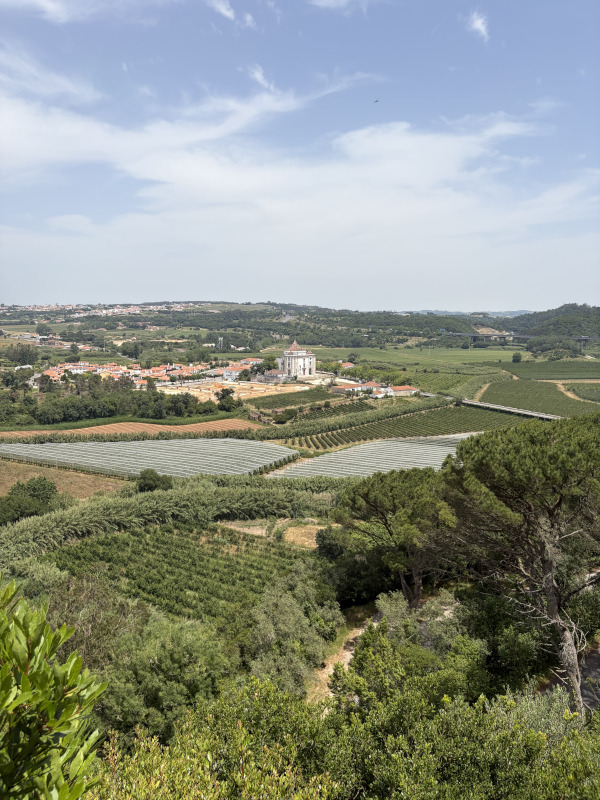
The fortified walls surround the historic centre of Óbidos, and you can walk about 1.5 kilometres along them. From above, you get excellent views over the red-tiled roofs, the castle and the plain surrounding the town.
A few centuries ago, the landscape looked very different. Óbidos Lagoon was much larger than it is today and covered part of the lowlands below the hill. Over time it silted up and receded, while former shallows and marshland became fields.
Take care: the walls are high, some passages are narrow and, in keeping with medieval safety standards, railings are largely absent. Avoid the walls if heights make you uncomfortable, and do not let children walk them unsupervised.
See the castle courtyard
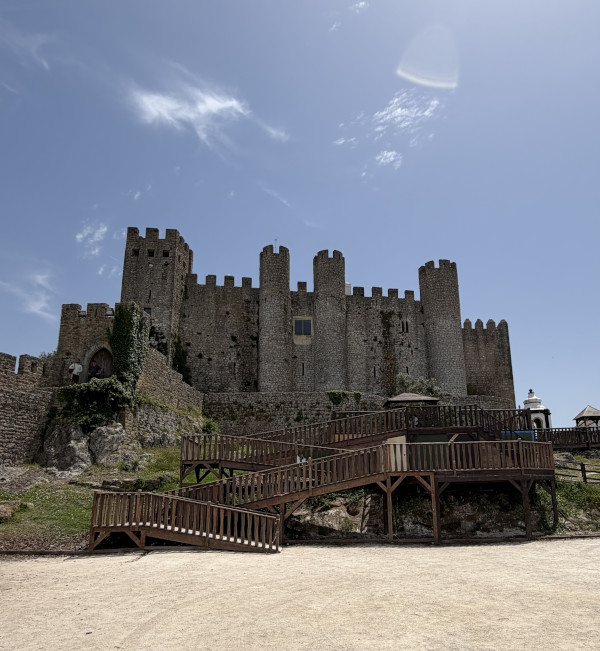
Óbidos Castle rises above the town. It is not a conventional castle museum that you can freely tour inside: today it houses the operating Pousada do Castelo hotel.
You can explore the defences and inner courtyard, pass through the far gate and see the siege tower, while also noticing how different the castle is from the familiar image of an isolated fortress: it forms part of a single defensive system with the town walls.
Nor is this exactly the castle that stood here during the Reconquista. Óbidos’s fortifications were repeatedly enlarged, rebuilt and restored over many centuries.
Step inside the Church of Saint Mary
The Church of Saint Mary (Igreja de Santa Maria) stands on the main square of the historic centre. Even if churches are not usually on your sightseeing list, it is worth stepping inside for the interior, painted azulejo tiles and the many layers of history concentrated in one place.
According to tradition, a Christian church stood here in Visigothic times, was later converted into a mosque and became a church again after Óbidos passed to the Portuguese kings. The present building is much younger and has itself been rebuilt several times.
In 1441, the future King Afonso V married Isabella of Coimbra here. One detail makes the event particularly memorable: the groom was ten years old and the bride was eight.
Leave Rua Direita
Rua Direita runs from the main town gate towards the castle and naturally becomes the route followed by most visitors. Shops, cafés and much of Óbidos’s tourist life are concentrated here.
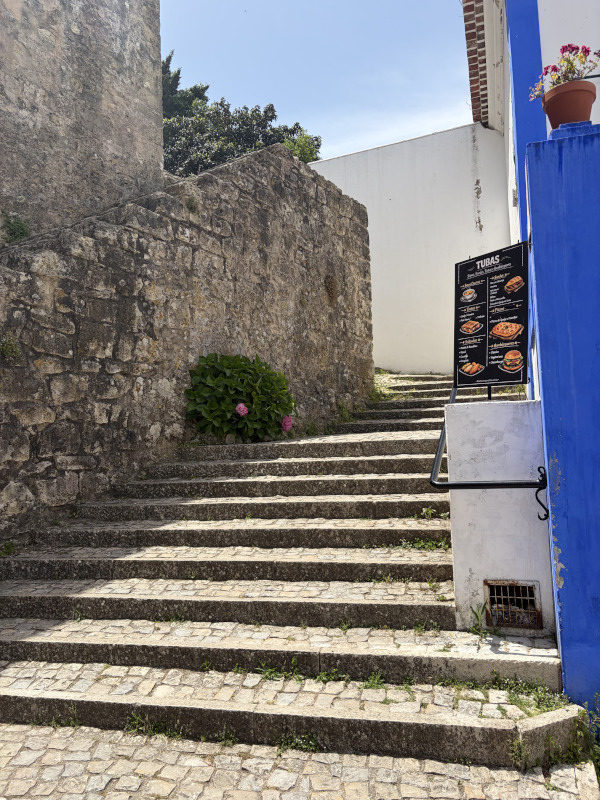
But turn into almost any side street and the town changes. Narrow stairways, little courtyards, white walls covered in flowers and unexpected passages lie only a few dozen metres from the main street — usually with far fewer people.
Óbidos is small enough that getting seriously lost is difficult, so sometimes the best route is simply to choose an unfamiliar lane and see where it leads.
Have a ginjinha
Ginjinha — or simply ginja — is a sweet Portuguese sour-cherry liqueur and one of the gastronomic symbols of Óbidos. The surrounding region is a traditional centre for growing sour cherries and making the liqueur: Ginja de Óbidos e Alcobaça has protected geographical indication (IGP/PGI) status.
The most tourist-friendly version is a small serving of ginjinha in a chocolate cup, which you eat along with the drink.
There is no need to hunt for the one “correct” shop on Rua Direita — although everyone will have their own favourite. Ginjinha is sold all over town, and stopping for a small glass fits perfectly into a slow walk through Óbidos.
Visit during a festival
Several times a year, the small historic centre of Óbidos changes completely. Large themed festivals take over the town, making a visit on those days very different from an ordinary walk.
Spring brings the International Chocolate Festival, summer the Óbidos Medieval Market, autumn the FOLIO literary festival, and before Christmas the town becomes Vila Natal, a Christmas village.
Festivals are another good reason to visit Óbidos, but they also mean bigger crowds and queues. During some events, activities take place in the castle courtyard and admission may be charged. If you want a quiet Óbidos, check the major event dates before you go.
Solve a mysterious murder
You can also explore Óbidos as an interactive detective story. Follow the route through the historic centre, look for clues in real locations and gradually discover what happened to a dead medieval knight.
It is a self-guided walking tour: there is no group to wait for and no fixed start time. All you need is your phone.